
Are you looking to expand your workforce OR are you keen to develop and retain your existing staff?
Apprenticeships can be a valuable way for Practices and PCNs to recruit new people into primary care while also developing the skills of existing employees.
They combine employment with structured training, giving individuals the opportunity to learn, develop new skills and gain recognised occupational competence while continuing to work.
Apprenticeships can support workforce development across a wide range of clinical and non-clinical roles and can provide structured career progression within primary care.
According to the Apprenticeship Evaluation 2023 Employer Survey, 86% of employers said apprenticeships helped them develop skills relevant to their organisation, while 77% reported improved productivity.
What is an Apprenticeship?
An apprenticeship is a paid job that combines practical workplace learning with structured training and study.
Apprentices are employees and receive a wage, holiday pay and dedicated time for training and study related to their role.
Apprenticeships aren’t only for new recruits or younger people. They can also be used to develop existing members of your workforce.
To start an apprenticeship in England, an individual must normally:
- Be aged 16 or over
- Live in England
- Not be in full-time education
- There is no general upper age limit.
Apprenticeships are available at different levels, including:
- Foundation and Intermediate apprenticeships – Level 2
- Advanced apprenticeships – Level 3
- Higher apprenticeships – Levels 4 to 7
- Degree apprenticeships – Levels 6 and 7
Depending on the apprenticeship, successful completion may also lead to an additional qualification or professional registration.
Apprenticeships in Primary Care
Apprenticeships offer a valuable opportunity to develop both new and existing Apprenticeships can help Practices and PCNs develop both new and existing employees across a wide range of clinical and non-clinical roles.
They can support workforce development in areas such as:
- Administration
- Finance
- Leadership and Management
- Healthcare Support
- Nursing
- Digital and IT
- HR and People Management
- Customer Service
- Clinical Practice
Examples of apprenticeship pathways that may be relevant to primary care include:
- Business Administrator – Level 3
- Healthcare Support Worker – Level 2
- Senior Healthcare Support Worker – Level 3
- Team Leader – Level 3
- Operations Manager – Level 5
- Accounts or Finance Assistant – Level 2
- Assistant Accountant – Level 3
- Nursing Associate – Level 5
- Registered Nurse Degree Apprenticeship – Level 6
- Senior Leader – Level 7
- Advanced Clinical Practitioner – Level 7
The Nursing Associate apprenticeship, for example, is a Level 5 apprenticeship and successful completion meets the education requirements for registration with the Nursing and Midwifery Council.
And there are many more apprenticeship opportunities available.
Availability will depend on the apprenticeship standard, training provider, entry requirements and funding eligibility.
The Training Hub can help you explore whether an apprenticeship is appropriate for the role you are considering and what funding options may be available.
Apprenticeship Service Account
Employers in England need an Apprenticeship Service account, sometimes referred to as a Digital Apprenticeship Service or DAS account, to manage apprenticeships and apprenticeship funding. All apprenticeships in England are arranged through the service.
Through the account, employers can manage apprenticeship funding and apprentice records, review and approve training costs, and give training providers permission to carry out certain functions on their behalf.
You will normally need details about your organisation and PAYE scheme when setting up your account. Employers are also required to accept the relevant employer agreement.
The below video shows you how:
A written guide can also be found here
What is the Salary of an Apprentice?
Apprentices are employees and must receive at least the appropriate statutory minimum wage.
Apprentices aged under 19
From 1 April 2026, the statutory apprentice minimum wage is £8.00 per hour.
For additional information about employing younger people within the NHS, see the existing NHS Employers guidance on recruiting under-18s. Recruiting under 18s into the NHS | NHS Employers
Apprentices aged 19 or over and in the first year of their apprenticeship
Apprentices aged 19 or over who are in the first year of their apprenticeship are also entitled to at least the statutory apprentice rate, currently £8.00 per hour from 1 April 2026.
Apprentices aged 19 or over who have completed their first year
Once an apprentice aged 19 or over has completed the first year of their apprenticeship, they must be paid at least the National Minimum Wage or National Living Wage applicable to their age
These are minimum statutory rates. Employers can choose to pay apprentices more than the minimum and may wish to consider the salary required to make vacancies attractive and competitive and support recruitment and retention.
Minimum wage rates normally change in April, so employers should always check the latest Government rates before recruiting.
Check the latest National Minimum Wage rates
Employer National Insurance Contributions
Employers may benefit from a zero rate of secondary Class 1 National Insurance contributions for qualifying apprentices aged under 25, on earnings up to the Apprentice Upper Secondary Threshold.
Employer National Insurance contributions may still be payable on earnings above that threshold.
Employers should check the latest HMRC guidance and ensure the appropriate National Insurance category is being applied through payroll.
How is Apprenticeship training funded
Apprenticeship funding can seem complicated, but the Training Hub can help you understand which route may apply to your organisation.
Funding will depend on factors including:
- Whether your organisation pays the apprenticeship levy
- The apprentice’s age when they start
- When the apprenticeship starts
- The apprenticeship level
- The relevant funding-band maximum
- Whether a levy transfer is available
The current national funding rules for apprenticeships starting between 1 August 2026 and 31 July 2027 are set out in the 2026 to 2027 apprenticeship funding rules. Different funding rules apply according to the apprenticeship’s start date.
Non-levy-paying employers
For eligible apprentices aged 16 to 24 who start an apprenticeship with a non-levy-paying employer from 1 August 2026, Government funding can cover eligible apprenticeship training and assessment costs up to the relevant funding-band maximum.
For apprentices aged 25 or over, non-levy employers will generally qualify for a levy transfer, which the training hub will support you to gain
Levy-paying employers
Levy-paying employers use funds available through their Apprenticeship Service account to support eligible apprenticeship training.
Levy transfers
Some employers may also be able to access a levy transfer, where another organisation transfers apprenticeship levy funding to support eligible apprenticeship training costs.
Funding arrangements are subject to eligibility and can change, so we strongly recommend checking the funding position before an apprentice is enrolled or a start date is agreed.
The Training Hub can support you in exploring the funding options available.
Are there mentor or supervision requirements?
Apprentices need appropriate support within the workplace to give them opportunities to develop and demonstrate the knowledge, skills and behaviours required by their apprenticeship.
The exact arrangements will depend on the apprenticeship standard and the requirements of the training provider.
Clinical and professionally regulated apprenticeships may also have additional requirements relating to supervision, placements and assessment.
Before starting an apprenticeship, employers should discuss these requirements with their chosen training provider so they understand the support and workplace learning opportunities that will need to be provided.
Off-The-Job Training
Off-the-job training is an important part of an apprenticeship.
It is training undertaken during the apprentice’s paid working hours which develops the knowledge, skills and behaviours needed to achieve their apprenticeship.
It is separate from the apprentice’s normal productive work, although it can take place within the workplace.
The amount of off-the-job training required depends on the apprenticeship standard. Under the current funding rules, the minimum volume of off-the-job training for individual standards is published by Skills England.
Off-the-job training could therefore include learning activities agreed with the training provider as part of the apprentice’s training plan.
Employers should discuss how this training will be accommodated before the apprenticeship begins.
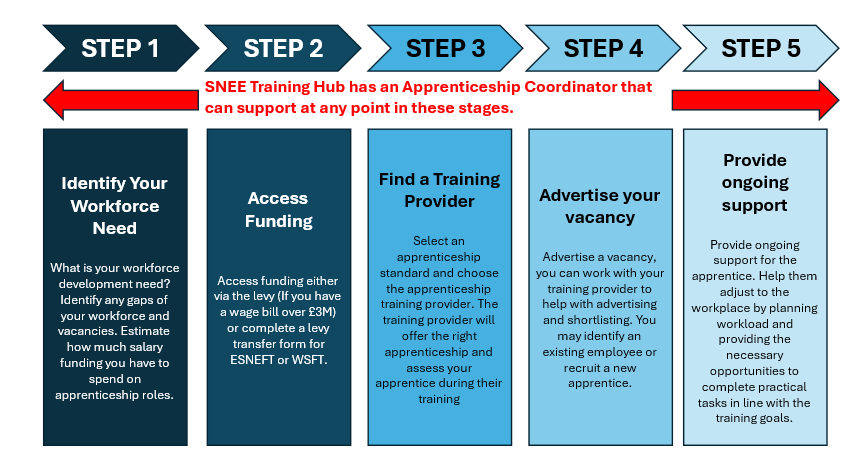
Steps to get started…
English and Maths / Functional Skills
English and maths requirements differ according to the apprentice’s age when they start their apprenticeship training.
Apprentices aged 16 to 18
Apprentices aged 16 to 18 at the start of their training who do not already hold suitable equivalent English and maths qualifications are required to achieve the relevant qualifications in order to complete their apprenticeship.
Funding is available for eligible apprentices to achieve up to an approved Level 2 qualification in these subjects where they do not already hold an accepted equivalent.
Apprentices aged 19 or over
For apprentices aged 19 or over at the start of their training, English and maths qualifications are not automatically a mandatory requirement for all apprenticeships. Some clinical apprenticeships do require apprentices to have English and maths qualifications.
If the apprentice does not already hold the required equivalent qualifications, the Training Hub can help arrange funded English and maths training up to an approved Level 2 qualification.
Employers and training providers should continue to consider the level of English and maths required for the employee’s role, apprenticeship and future career development.
Read the Government guidance on English and maths requirements
For more information or clarification about English, maths or Functional Skills requirements, please contact the Training Hub.
We’re Here To Help!
Whether you’re thinking about recruiting an apprentice, developing an existing member of staff, exploring a career progression opportunity or simply trying to understand the funding, the Training Hub can help you explore your options.
There are apprenticeships suitable for a wide range of clinical and non-clinical roles across primary care, and we can help you understand the options available to your Practice or PCN.
Get in touch with the Training Hub to discuss your apprenticeship requirements.
Career Pathways
Some examples of career pathways in Primary Care:
Additional Information
Training Providers in the area:
- West Suffolk College Apprenticeships
- Colchester institute Apprenticeships | Apprenticeship Training – Colchester Institute
- Suffolk New College Apprenticeships – Suffolk New College
- University of Suffolk Degree Apprenticeships | University of Suffolk
- University of Essex Apprenticeships | University of Essex
- Anglian Ruskin University Course search – ARU
Useful Resources:
TO REQUEST FURTHER INFORMATION:
The Training Hub remain committed to supporting Primary Care to access Apprenticeships and the benefits they bring to workforce planning.
If you would like further information or support or have any questions, click below to email us: